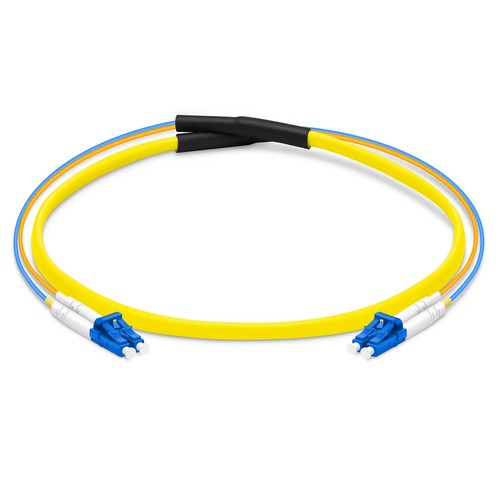
Kenyan network installers should begin with the actual mating interfaces and site fiber records before assigning this product to a link. This project-specific multi-fiber cable is a pre-terminated indoor product built exactly to the arrangement the project specifies: connector styles and polish at each end, fiber count, jacket rating, breakout geometry and length are all specified at order time, and the finished trunk is optically tested leg by leg before dispatch. The flat structure packs the fibers in a low-profile ribbon-like trunk with 1.6mm breakout legs, a geometry that lies flat under floor coverings and in shallow channels where a round cable will not fit.
Product Highlights
- Precision Zirconia Ferrule Connectors Ensure Low Loss
- Available in Riser (OFNR)/LSZH/Plenum (OFNP) Flame-Retardant Trunk Jacket
- Available in LC/SC/FC/ST/LSH Connector Type
- Optical Performance Test for Normal Network Connections
- G.657.A1 Bend Insensitive Fiber with 10mm Min. Bend Radius
Specifications
| Connector Type | LC/SC/ST/FC/LSH |
|---|---|
| Polish Type | UPC/APC |
| Fiber Count | 2 Fibers |
| Fiber Grade | G.657.A1 (Compatible with G.652.D) |
| Fiber Mode | OS2 9/125μm |
| Wavelength | 1310/1550nm |
| Flame Rating (Trunk) | Riser (OFNR)/LSZH/Plenum (OFNP) |
| Breakout Length | |
| Trunk Outside Diameter (OD) | (2.6±0.1) x (4.2±0.2)mm |
| Breakout Outside Diameter (OD) | 1.6mm |
| Polarity | A (Tx) to B (Rx) |
| Cable Type | Tight-Buffered |
| Min. Bend Radius (Optical Fiber) | 10mm |
| Min. Bend Radius (Fiber Cable) | 20/10D (Dynamic/Static) |
| Tensile Strength | 60/220N (Long/Short Term) |
| Insertion Loss | ≤0.3dB |
| Return Loss | UPC≥50dB, APC≥60dB (LC/SC/ST/FC) |
| Attenuation at 1310nm | 0.4dB/km |
| Attenuation at 1550nm | 0.3dB/km |
| Operating Temperature | Plenum (OFNP): 0 to 60°C (32 to 140°F) |
| Storage Temperature | Plenum (OFNP): -10 to 70°C (14 to 158°F) |
Single-mode trunks for building and campus backbones
A pre-terminated OS2 trunk carries the links that leave the room: riser spans between floors, campus backbones between buildings and every wavelength-multiplexed service in between. Because the glass is the matching class used in the outside plant, the cable assembly will not become the weak point of the loss calculation. At 1310 and 1550nm the attenuation stays a fraction of a decibel per kilometer, and each factory-polished connector adds less than 0.3dB when the end faces are clean and seated.
Connector and polish discipline on single-mode links
Single-mode plants are unforgiving about polish mismatches: a UPC leg mated into an APC port destroys the return loss and can damage both ferrules. Because this cable assembly is built with the polish specified at order time and tested as a full trunk, the patch side matches the adapter panel side exactly. When documentation is unclear, the boot color tells the truth: green for APC, blue for UPC.
Pulling eye and installation practice
A pre-terminated trunk is only as good as its journey through the pathway. The optional pulling eye protects the connectorized end during the pull and keeps the trunk cable from twisting, which matters on long riser runs and congested trays. The installation load rating on the datasheet is the number the pulling rope should respect, not the weight of the reel.
Breakout geometry and why it matters
The breakout is where a trunk becomes usable. Equal-length legs suit a straight row of adjacent ports, whereas staggered legs reach a column of ports without slack piling up at one end. The 2.0mm legs survive patching-field handling; the 0.9mm model suits protected routing inside panels and cassettes. Specifying the geometry at order time means the cable assembly arrives matching the hardware it serves.
Pre-terminated versus field termination
Terminating OS2 fiber in the field means a splicer, a tray slot, consumables and the craft time to do it well - multiplied by every fiber in the trunk cable. A pre-terminated product moves all of that work to the factory floor, where polishing, inspection and testing happen under controlled conditions. The installer who receives the optical cable routes it, dresses the legs and mates the optical connectors; the channel is ready for light the matching hour. Since every field-terminated leg is one more chance for a rework visit, for multi-fiber counts the saving is never linear but compounding,.
Planning a trunk route
A multi-fiber trunk is planned once and deployed once; therefore, the planning deserves the hour it takes. Measure the pathway through the actual containment, note the bend space at both connector ends, and decide which end gets pulled. State the pulling eye specification with the order if the pathway is long or congested. At the far end, leave the dressing slack the adapter panel or cassette needs - the datasheet breakout lengths are the default, and other geometries are confirmed before manufacturing.
Selecting the Fiber Count
This structure is built with 2 Fibers per trunk, terminated and tested as a full product.
Made-to-Order Lengths
Regular lengths cover the common routes: 1m (3ft), 2m (7ft), 3m (10ft), 5m (16ft), 10m (33ft), 15m (49ft), 20m (66ft), 30m (98ft), 25m (82ft), with project-specific length obtainable beyond the list, including foot-based builds for projects specified in imperial units. Specifying the measured pathway length keeps the slack out of the tray and the strain off the optical connectors.
Factory Testing and Quality Checks
Every trunk is terminated with precision zirconia ferrule connectors and optically tested leg by leg before packing: insertion loss and return loss are verified on each fiber, and end-face geometry is inspected for consistent physical contact. The cable assembly ships with dust caps on every connector and the test results obtainable on ask for.
How to Order and Factory Support
Refer to this arrangement by fiber mode, fiber count, connector pair, breakout geometry and length when asking for a quotation. For configurations outside the listed options - mixed connector families, jacket ratings, pulling eye, marking or project packaging - send the specification with the request and the factory will check the build before manufacturing. Project support for Kenya and East Africa is available to reconcile the ordered configuration with the intended installation.