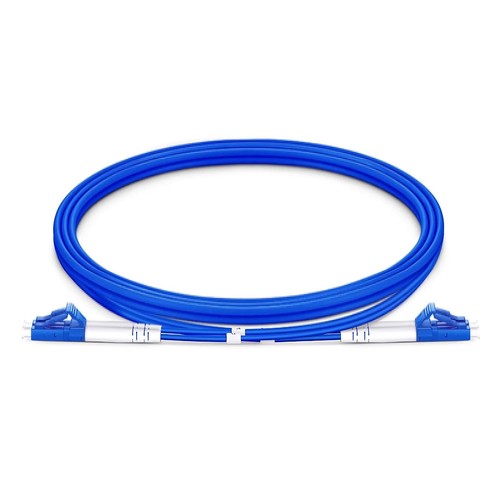
Kenyan network installers should begin with the actual mating interfaces and site fiber records before assigning this product to a link. This duplex armored patch cable terminates two LC UPC connectors on an OS2 9/125µm single-mode product with a low smoke zero halogen jacket over a helical stainless steel tube. It answers the listed specifications that forbid PVC and riser compounds: tunnels, stations, ships, high-occupancy buildings and data halls where smoke and corrosive gas from a burning cable are treated as seriously as the fire itself.
Product Highlights
- LSZH jacket: low smoke, zero halogen in a fire
- Helical stainless steel armor against crush, impact and rodents
- G.657.A1 bend-insensitive fiber, 10/5D bend radius
- Insertion loss ≤0.3dB, return loss ≥50dB
- Stock lengths 1m to 30m; custom lengths and jackets on request
- LC UPC to LC UPC duplex, OS2 9/125µm single mode
Specifications
| Connector Type | LC to LC |
|---|---|
| Polish Type | UPC to UPC |
| Fiber Mode | OS2 9/125µm |
| Wavelength | 1310/1550nm |
| Fiber Count | Duplex |
| Fiber Grade | G.657.A1 (Compatible with G.652.D) |
| Min. Bend Radius (Fiber Cable) | 10/5D (Dynamic/Static) |
| Cable Outside Diameter (OD) | 3.0mm |
| Flame Rating | LSZH (Low Smoke Zero Halogen) |
| Construction Type | Single Armored, Stainless Steel Tube |
| Tensile Strength | 120/225N (Long/Short Term) |
| Insertion Loss | ≤0.3dB |
| Return Loss | ≥50dB |
| Operating Temperature | -20 to 70°C (-4 to 158°F) |
| Storage Temperature | -40 to 70°C (-40 to 158°F) |
LSZH jackets for occupied and enclosed spaces
When standard jacket compounds burn, they release dense smoke and corrosive halogen gases; in a tunnel, metro station, ship or packed office, that smoke is commonly the greater danger to people and to electronic equipment. LSZH compounds drastically reduce both. Wherever the building specification names low smoke zero halogen cabling, this is the armored cord that meets it without giving up mechanical protection.
Same OS2 core as the riser version
Optically this cable assembly is identical to the OFCR-rated LC-LC cord: the matching G.657.A1 bend-insensitive glass, the matching 0.3dB insertion loss ceiling, the matching 1310/1550nm single-mode window. The difference is only the jacket arrangement. That means a project can mix LSZH and riser versions across building zones while keeping one optical specification and one supplier part range.
Armor plus LSZH: protection inside and out
The steel tube protects the fibers from the building; the LSZH jacket protects the building occupants from the optical cable. The combination suits evacuation routes, public concourses, transport hubs and any pathway where an armored cord would normally raise a jacket-compliance question. The cord stays 3.0mm and dresses exactly like a standard jumper.
Specifying LSZH in project documents
When the project specification calls for LSZH, name it on the cord layout explicitly rather than assuming the jacket follows the backbone cable. Patch leads are frequently procured independently and default to riser compounds. This range makes the LSZH specification easy to satisfy, since the LSZH build carries the matching optical and mechanical ratings as the riser variant, differing only in the jacket compound.
Standard lengths and custom builds
Regular lengths are stocked for fast delivery: 1m (3ft), 2m (7ft), 3m (10ft), 5m (16ft), 10m (33ft), 15m (49ft), 20m (66ft) and 30m (98ft), covering the common rack-to-rack, access and frame connections this cord is built for. Project-specific lengths beyond this range are manufactured to order. In public-zone installations the pathway is generally surveyed in advance; therefore, ordering to the measured length keeps excess cable out of the evacuation pathway. Specifying the specific pathway length avoids both the slack storage problem of an overlong cord and the strain risk of one that is too short.
Factory testing and quality checks
Every assembly is terminated with precision zirconia ferrule LC connectors and measured for insertion loss and return loss before packing; the 0.3dB and 50dB figures are verified per cord. End-face geometry is inspected for consistent physical contact, and the LSZH jacket is batch-tested for the compound it is specified to be. Kenyan installers can add this check to the handover record for future maintenance and fault tracing.
How to Order and Factory Support
Use against the LC-LC OS2 LSZH armored range with the pathway length stated and the LSZH specification referenced. Hybrid LC-SC and SC APC versions exist in the matching jacket arrangement, and further connector mixes are obtainable through the project-specific armored program. Project support for Kenya and East Africa is available to reconcile the ordered configuration with the intended installation.