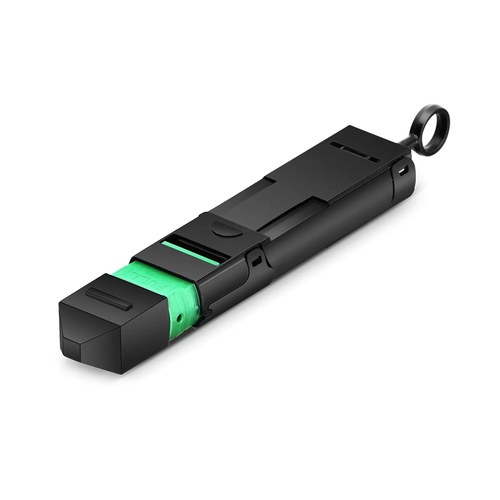
This 12 loopback module provides a compact optical self test for parallel ports. It routes transmit lanes back to the receive lanes inside a rugged housing, so you can verify port function, run burn-in tests and diagnose link faults without a second device.
Product Highlights
- Fiber Type: OS2 9/125μm
- Fiber Connector: MTP® Female, APC
- Insertion Loss: SM (G657.A2)≤1.5dB
- Return Loss: SM>50dB
- Insert-Pull Test: 50times, IL Change<0.5dB
- Factory tested, individually packed
Specifications
| Part Number | LPM-SM-12MTP |
|---|---|
| Manufacturer | HT |
| Fiber Type | OS2 9/125μm |
| Fiber Connector | MTP® Female, APC |
| Insertion Loss | SM (G657.A2)≤1.5dB |
| Return Loss | SM>50dB |
| Insert-Pull Test | 50times, IL Change<0.5dB |
| Size | 80mm*10mm |
| Operation Temperature | -40 to 75°C (-40 to 167°F) |
| Housing Material | PC |
Applications
Typical uses are switch and NIC port validation in production, burn-in testing before shipment, troubleshooting suspect links in the field, and verifying cabling channels end to end. It lets a single technician confirm that a parallel port transmits and receives correctly on every lane.
Using the Loopback Correctly
A loopback contains no electronics: it simply connects transmit fibers to receive fibers inside the housing. The port under test sees its own signal returned, so link indicators and diagnostics behave as if a far-end device were connected. Always check the required attenuation for high power interfaces.
Ordering Information
Ordering is simple: send us LPM-SM-12MTP and your required lengths and quantities, and we return a factory quote the same working day. Small trial orders are welcome before you commit to a full project rollout.
Logistics
Standard configurations normally ship within a few working days by DHL, UPS, FedEx, TNT or EMS. For project quantities we arrange air or sea freight, and we can ship on your own courier account or deliver to your appointed forwarder.
Quality and Testing
Our test routine covers insertion loss, return loss and ferrule end face inspection on every assembly. Because testing is done in-house, custom variants receive exactly the same verification as standard models.
How We Pack
Products are packed in anti-static or PE bags with connector dust caps fitted, then boxed in sturdy export cartons. Custom labels, barcodes and carton markings are available on request.