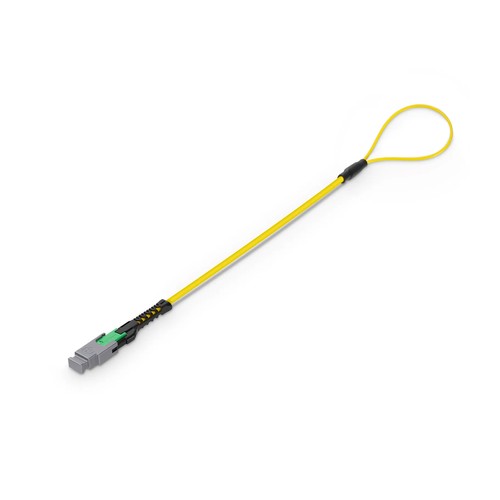
Kenyan network installers should begin with the actual mating interfaces and site fiber records before assigning this product to a link. This fiber loopback module supplies a self-contained optical channel that returns the transmit signal directly into the receive path of the port under test: 16F, OS2, in a MMC arrangement. Plugged into the interface, it lets a single technician check transmitter output, receiver sensitivity and port assignment without a second device, a patch cord pair or a far-end loop.The MMC interface serves the newest generation of densely populated optical modules, where the optical connector footprint is smaller than the MPO format used in previous generations.
Product Highlights
- Easy Insertion and Extraction with DirectConec™ Push-Pull Boot
- Type 1 Fiber Mapping for Accurate Loopback and Port Verification
- Low Insertion Loss ≤0.7dB, High Return Loss ≥60dB
- OFNP Cable for Reliable Data Center Testing
- High-Density 16 Fibers MMC Design for Transceiver Testing
Specifications
| Fiber Type | OS2 9/125μm |
|---|---|
| Fiber Connector | MMC Female, APC |
| Cable Jacket | Plenum (OFNP) |
| Fiber Count | 16 Fibers |
| Type 1 | Insertion loss |
| Return Loss | ≥60dB |
| Min. Bend Radius (Optical Fiber) | 7.5mm |
| Min. Bend Radius (Fiber Cable) | 20/10D (Dynamic/Static) |
| Storage Temperature | -20 to 75°C (-4 to 167°F) |
| Type 1 fiber mapping connects corresponding transmitter and receiver channels to establish the correct loopback path, enabling accurate channel verification and reliable transceiver testing. | Questions & Answers |
What loopback testing actually proves
A loopback module closes the optical circuit inside one device: the transmitter launches light, the loopback module returns it, and the receiver must lock onto its own signal. When the channel comes up clean under those conditions, the port has proven its transmitter power, its receiver sensitivity and its internal signal integrity in one step. It is the fastest way to independent a bad port from a bad cable plant, since the optical cable plant is entirely removed from the test.
Burn-in and production-line testing
Switch and transceiver manufacturers run loopback modules through thousands of insertion cycles on the production line: every port of every unit is exercised before the item ships. The insert-pull test rating on this loopback module reflects that duty - the housing, latch and ferrule are built to survive repeated daily mating without the insertion loss drifting beyond its specification.
Loopback testing for MMC-interface optics
MMC is the optical connector of the newest densely populated optical modules, packing more fibers into a smaller footprint than MPO. Testing those ports requires a loopback built on the matching interface: this loopback module mates directly with the MMC port and returns all lanes to their receivers with Type 1 assignment, giving the matching one-step port verification that MPO loopbacks supply for the previous generation.
High-fiber-count testing without a fan-out
With 16 or 24 fibers on one small connector, breaking the lanes out to individual testers is never practical. The loopback keeps the whole test inside the port: every lane is exercised collectively, and the host arrangement reports per-lane status. What would take an afternoon with fan-out leads and a power meter becomes a single insertion and a readout.
Type 1 fiber mapping and channel alignment
Inside a multi-fiber loopback, the assignment decides which transmit lane returns to which receive lane. Because type 1 assignment pairs the lanes in the order the optics expect, each path of the port under test sees its own signal returned on the appropriate receiver. A wrong assignment produces crossed lanes, which looks exactly like a wiring fault and wastes hours of diagnostics - the assignment is marked on the loopback module so the test setup is unambiguous.
Handling, wear and service life
A loopback module is a precision test tool, and it stays one only while its latch, housing and ferrule survive daily duty. The insert-pull rating is generous, but it is never infinite: track the mating count in the test log, and retire a module that has served a production line for years before its wear becomes the hidden cause of failing ports. A worn latch that seats loosely adds loss that masquerades as a bad receiver - the cheapest instrument in the kit can waste the most expensive hours.
A bench test workflow that scales
The productive way to use loopbacks is a fixed routine: check the loopback module ferrule, mate it with the port, bring the interface up, record the per-lane status and the receive power, then unmate and cap the loopback module immediately. With the routine fixed, a technician qualifies a full chassis of ports in the time an improvised setup spends on one line card. The consistency further makes the records comparable - the matching module, the matching method, the matching pass criteria across every site and every batch of hardware.
Sparing and kit planning
Loopbacks belong in every commissioning kit the way a known-good patch cord does. Plan one module per interface type per crew, plus a spare that stays sealed in its bag; the cost of an extra module is trivial against a truck roll to re-test a suspect port. Label each module with its interface, fiber count and attenuation so the right one comes out of the bag on the first try, and log its insertion count so a worn test tool never becomes the hidden cause of failing ports. Kenyan installers can add this check to the handover record for future maintenance and fault tracing.
Selecting the right loopback for the task
Four decisions define the loopback module: the optical connector interface must match the port under test, the fiber count must cover the lanes the optics use, the assignment type must pair the lanes the way the transceiver expects, and the attenuation must reflect the channel budget the test plan calls for. Getting all four right at order time is what turns a loopback from a drawer of adapters into a dependable instrument. When the specification sits outside the standard configurations, the factory can check a made-to-order build - connector combinations, assignment variants and other attenuation ratings are all manufacturable options.
Factory Testing and Quality Checks
Every loopback module is optically tested before packing: insertion loss of the full loop is verified against the specification, and the ferrule end faces are inspected for scratches and contamination. The loopback module ships with its dust cap fitted and the test result obtainable on ask for.
How to Order and Factory Support
Refer to this loopback module by connector interface, fiber count, polish and attenuation when asking for a quotation. For other attenuation ratings, assignment types or connector combinations, send the test specification with the request and the factory will check the manufacturable specification. Project support for Kenya and East Africa is available to reconcile the ordered configuration with the intended installation.