QSFP28 to QSFP28-100G-DAC-0.5M2FT 100G QSFP28 4 x 25G NRZ Passive Copper Twinax Cable, 0.5m (2ft)
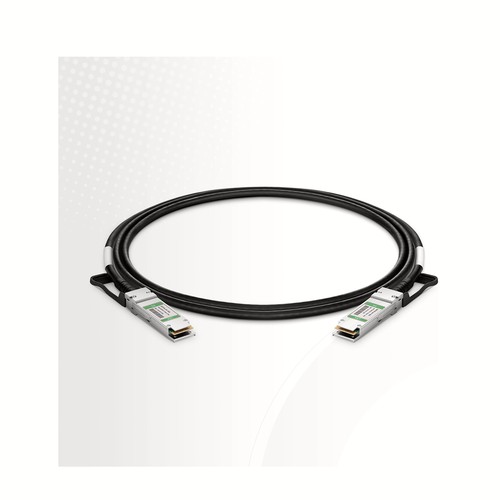
This page gives procurement and network teams a precise reference for Generic QSFP28 to QSFP28-100G-DAC-0.5M2FT: a 100G DAC assembly in a fixed 0.5m (2ft) configuration. The QSFP28 to QSFP28 interface, HT ordering identity and verified specifications are presented together so the required cable can be matched to the bill of materials without confusing it with another length.
OEM Part Number: QSFP28 to QSFP28-100G-DAC-0.5M2FTHT Part Number: QSFP28 to QSFP28-100G-DAC-0.5M2FT
Product Highlights
- HT-manufactured DAC assembly in 0.5m (2ft)
- 100G connectivity at 100Gbps
- Interface configuration: QSFP28 to QSFP28
- Fixed length and part number: 0.5m (2ft), QSFP28 to QSFP28-100G-DAC-0.5M2FT
- Cable construction: Passive Twinax
- Conductor specification: 30AWG
- Maximum power consumption: ≤0.5W
- Minimum bend radius: 33.5mm
Specifications
| HT Part Number | QSFP28 to QSFP28-100G-DAC-0.5M2FT |
|---|---|
| Manufacturer | HT |
| Form Factor | QSFP28 to QSFP28 |
| Max. Data Rate | 100Gbps |
| Media | Copper |
| Cable Type | Passive Twinax |
| Cable Length | 0.5m (1.64ft) |
| Jacket Material | PVC (OFNR) |
| Minimum Bend Radius | 33.5mm |
| Wire AWG | 30AWG |
| Max. Power Consumption | ≤0.5W |
| Modulation Format | 4x 25G-NRZ to 4x 25G-NRZ |
| Power Supply | 3.3V |
| MTBF | ≈50 Million Hours |
| Commercial Temperature Range | 0 to 70°C (32 to 158°F) |
| Application | 100G Ethernet |
| Protocols | QSFP28 MSA, SFF-8662, IEEE 802.3 |
Signal and Lane Configuration
The listed modulation format is 4x 25G-NRZ to 4x 25G-NRZ. Both host interfaces must be configured for the same aggregate rate and lane arrangement. A connector that fits mechanically does not by itself guarantee that the remote port supports this encoding or breakout mode.
Network and Protocol Considerations
The intended application is 100G Ethernet. Listed interface and protocol references include QSFP28 MSA, SFF-8662, IEEE 802.3. Confirm that the host firmware and port configuration support the same operating mode.
Passive Copper Operation
A passive DAC has no separate optical conversion stage. Its low-power, low-latency operation is useful for short equipment links, but the assembly must remain within the length and signaling mode accepted by both hosts.
Length Selection and Installation Planning
The 0.5m (2ft) length is suited to closely aligned ports where excessive slack would obstruct airflow or complicate dressing. Measure the actual port-to-port path before choosing QSFP28 to QSFP28-100G-DAC-0.5M2FT; even a short assembly must retain the specified bend radius and should never be pulled tight behind the equipment.
Position Within the Length Range
QSFP28 to QSFP28-100G-DAC-0.5M2FT is the shortest of 6 verified length options in this family. It is the preferred choice when the port positions are close and cable slack must be kept to a minimum. The next option is QSFP28 to QSFP28-100G-DAC-1.5M5FT at 1.5m (5ft), adding 1m for a less direct routing path; selecting it unnecessarily would leave more cable to dress.
Procurement and Port-Mapping Review
A useful purchase order should identify the host platform, the expected OEM code and the exact cable length as separate pieces of information. This prevents a physically similar assembly from being substituted when the port identification or reach is different. For mixed-length installations, prepare one order line per part number and reconcile each delivered cable with its intended pair of ports. For this assembly, the listed conductor specification is 30AWG; the minimum bend radius is 33.5mm; the stated power consumption is ≤0.5W; the jacket material is PVC (OFNR).
Power and Thermal Planning
The rated power consumption is ≤0.5W. Include this load in the host-port power and thermal budget, especially in densely populated switches. Maintain front-panel clearance and do not bundle the cable so tightly that it obstructs airflow around the connectors.
Cable Construction and Routing
This assembly uses 30AWG conductors, PVC (OFNR) jacket, minimum bend radius 33.5mm. These mechanical characteristics affect how the cable should be dressed behind the equipment. Avoid sharp edges, excessive ties and repeated tight bends close to the connector boots.
Generic Compatibility and Factory Testing
Our procurement-oriented compatibility check begins with the OEM reference and ends with a live host link. We record the physical length separately from the identification configuration, so the cable supplied for this page remains the stated version rather than a generic length substitute. The check includes link stability and diagnostic indications, followed by a final inspection of both ends.
Ordering Information
For a clear bill of materials, quote the OEM reference, HT part number, length and quantity on the same line. Add the switch or server model and software release when a pre-order review is required; project labels can repeat those details for receiving and installation teams. Quantity and any labeling instructions should be attached specifically to QSFP28 to QSFP28-100G-DAC-0.5M2FT.
Quality Assurance and Packaging
Before packing, the assembly is checked for connector condition, identification and link operation. Cables for multi-line orders can be labelled and grouped by part number, making it easier to match each length to the procurement record without opening every protective bag. Standard protective packing is used by default, with project documentation arranged when requested.
Frequently Asked Questions
Is this an original equipment manufacturer cable?
No. It is manufactured by HT under our own manufacturer identity.
Are separate transceivers or patch leads required?
No. This is one complete direct-attach assembly. The ends are not detachable modules and should not be separated from the cable.
Can excess cable be folded into a compact bundle?
No. Use a supported, bend-safe service loop and observe the listed minimum bend radius. Do not crease the cable or tighten ties around the connector boots.
Will any matching connector operate at the same speed?
Not necessarily. Both hosts must support the stated rate, identification, lane mapping and any required breakout configuration; mechanical compatibility alone is insufficient.
Shipping and Lead Time
Standard configurations normally ship within one to three working days, while production quantities are confirmed with the order. Worldwide courier services are available, with air or sea freight for consolidated shipments; freight-collect delivery and coordination with a customer’s logistics provider can be arranged.