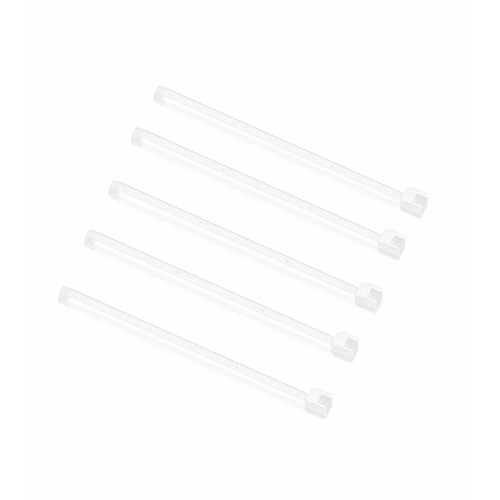
Kenyan network installers should begin with the actual mating interfaces and site fiber records before assigning this product to a link. Universal Dust Cap for 1.25mm Ferrule with Jacket Strap belongs to the small hardware that keeps a fiber plant healthy between moves and changes. Dust, handling and open ports are the everyday enemies of optical performance; the right caps, chains and mounting clips keep connector end faces clean and adapters seated until the day the port goes live. Kenyan installers can add this check to the handover record for future maintenance and fault tracing.
Product Highlights
- It is Not Easy to Lose When Hanging on The Optical Fiber
- Protects Fiber Optic Adapters and Couplers from Contamination and Damage
- Protective Dust Cap Protects Adapter from Dust Ingress
- Avoid Severe Network Slowdowns or Crashes
- Easy Installation and Removal
Specifications
| Color | White |
|---|---|
| Material | PP |
| Durability | ≥ 500 (cycles) |
| Operating Temperature | -40 to 85℃(-40 to 185℉) |
| Storage Temperature | -10 to 60℃(14 to 140℉) |
| Dust-proof, moisture-proof, and oxidation-proof, protects fiber optic assemblies from debris and other contaminants that can degrade optimal functionality. | Not Easy to Fall After Installation |
| Dust-proof Plug | Long Tail |
Phosphor bronze and zirconia sleeves compared
Two sleeve materials dominate the mating adapter market. Zirconia ceramic sleeves give the tightest alignment and are the appropriate selection for single-mode and high-performance multimode work, where core geometry leaves no room for eccentricity. Phosphor bronze sleeves serve legacy multimode and metallic-ferrule connectors where the tolerance specification is looser and the cost matters more. Matching the sleeve to the application keeps both performance and budget under control.
Small hardware that keeps panels serviceable
Adapter accessories cover the gaps the catalog hardware leaves: caps that keep unused ports clean, chains that keep the cap attached to the adapter panel so it cannot walk away, mounting clips that adapt one footprint to one more cutout. None of these parts carry light, yet the plant fails without them - a missing cap becomes a contaminated port, a missing clip becomes an adapter that cannot mount. Keep the accessories stocked with the adapters they serve.
Dust caps as a working discipline
Every contamination investigation ends at the matching place: an end face that sat open to the air. Dust caps exist to close that gap, and they only work when the discipline is real - the cap goes on the moment the optical connector comes out, every time, no exceptions for "just a minute". Caps cost almost nothing; the cleaning rounds and the re-polished connectors they prevent cost real labor. Treat caps as part of the optical connector, not as packaging to throw away.
What adapter testing actually measures
An adapter contributes no signal of its own; therefore, its test is a mating test: reference connectors mate through the mating adapter, and the inserted loss is recorded. A zirconia-sleeve adapter should add no more than 0.2 dB, and the mating must repeat that figure across cycles. Durability testing runs the mating hundreds of times and re-measures - a sleeve that wears loose announces itself as creeping loss. These figures, not the housing color, are what separates an adapter that serves for years from one that becomes the mystery fault.
Selecting the right adapter for the panel
Five decisions define the mating adapter order: the optical connector pairing must match both sides of the mating, the mounting style must fit the adapter panel cutout, the polish color code must match the plant, the sleeve material must suit the performance grade, and the count must cover the load-out plus spares. Getting all five right at order time is what turns a bag of couplers into a dependable panel. Where the pairing crosses connector families, the hybrid range covers the common conversions.
Factory Testing and Quality Checks
Every adapter is inspected before packing: the sleeve bore is checked for alignment and surface finish, the housing latches are cycled for positive engagement, and sample matings from each production lot are measured for insertion loss. Accessories are checked for fit against the adapters they serve. Kenyan installers can add this check to the handover record for future maintenance and fault tracing.
How to Order and Factory Support
Refer to this adapter by connector pairing, mounting style, polish grade and pack number of units when asking for a quotation. For configurations outside the listed options - mixed packs, panel hardware kits or project packaging - send the specification with the request and the factory will check the manufacturable specification. Project support for Kenya and East Africa is available to reconcile the ordered configuration with the intended installation.