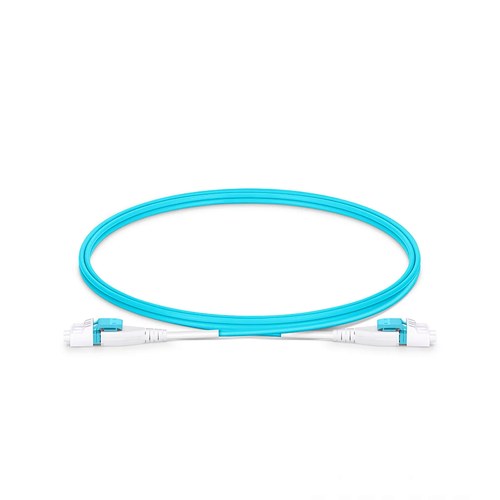
Kenyan network installers should begin with the actual mating interfaces and site fiber records before assigning this product to a link. This OM4 fiber patch cable carries a LC UPC interface on one end and a LC UPC interface on the other, factory terminated on OM4 glass and optically tested as a full product. The uniboot structure places both fibers of the duplex channel inside a single round 2.0mm cord with one combined connector housing, halving the optical cable count in densely populated panels and simplifying polarity management.
Product Highlights
- Uniboot Allows One Cable to Carry Two Fibers to Reduce Cable Congestion in High-Density Patch Fields
- Bend Insensitive Fiber with 7.5mm Min. Bend Radius
- Flat Clip Design Provides Additional Space Between Connectors and Improves Airflow
- Reverse Polarity without Exposing the Fibers or Needing Any Tools
- Termination Is Tested to Ensure Network Performance
Specifications
| Fiber Count | 2 Fibers |
|---|---|
| Fiber Grade | Bend Insensitive Fiber |
| Fiber Mode | OM4 50/125μm |
| Wavelength | 850/1300nm |
| Flame Rating | LSZH |
| Cable Outside Diameter (OD) | 2.0mm |
| Polarity | A (Tx) to B (Rx) |
| Tensile Strength | 60/100N (Long/Short Term) |
| Min. Bend Radius (Optical Fiber) | 7.5mm |
| Min. Bend Radius (Fiber Cable) | 20/10D (Dynamic/Static) |
| Insertion Loss | ≤0.2dB |
| Return Loss | ≥30dB |
| Attenuation at 850nm | ≤3.5 dB/km |
| Attenuation at 1300nm | ≤1.5 dB/km |
| Operating Temperature | -10 to 70°C (14 to 158℉) |
| Storage Temperature | -20 to 70℃ (-4 to 158℉) |
Why OM4 replaced OM3 in new builds
OM4 raises the effective modal bandwidth to 4700 MHz·km at 850nm, and that headroom translates directly into reach for the higher-speed interfaces. Because the price difference against OM3 has largely disappeared, new cabling plants standardize on OM4 and keep OM3 only for matching current installations.
Polarity and pairing in duplex links
A duplex jumper is two fibers with a defined A-to-B crossover. Getting polarity right at the cord level keeps the path consistent end to end, which is why these assemblies are built and tested as a pair rather than as two distinct strands.
One cord, two fibers
The uniboot design merges the duplex pair into a single round cord and a single connector housing. In a 400G row where every QSFP-DD port consumes a duplex channel, halving the cord count visibly changes the airflow and the manageability of the patching field.
Length Options
Regular lengths cover the common patching routes: 1m (3ft), 3m (10ft), with project-specific length obtainable beyond the list. Specifying the measured pathway length keeps the slack out of the manager and the strain off the optical connectors.
Quality Control and Testing
Every assembly is terminated with precision zirconia ferrule connectors and optically tested before packing: insertion loss and return loss are verified on each cable, and end-face geometry is inspected for consistent physical contact. The optical cable ships with dust caps on both connectors and the test result obtainable on ask for.
Ordering and Factory Support
Refer to this arrangement by connector pair, fiber mode and length when asking for a quotation. For configurations outside the listed options, mixed connector families, jackets, marking or project packaging, send the specification with the request and the factory will check the build before manufacturing. Project support for Kenya and East Africa is available to reconcile the ordered configuration with the intended installation.